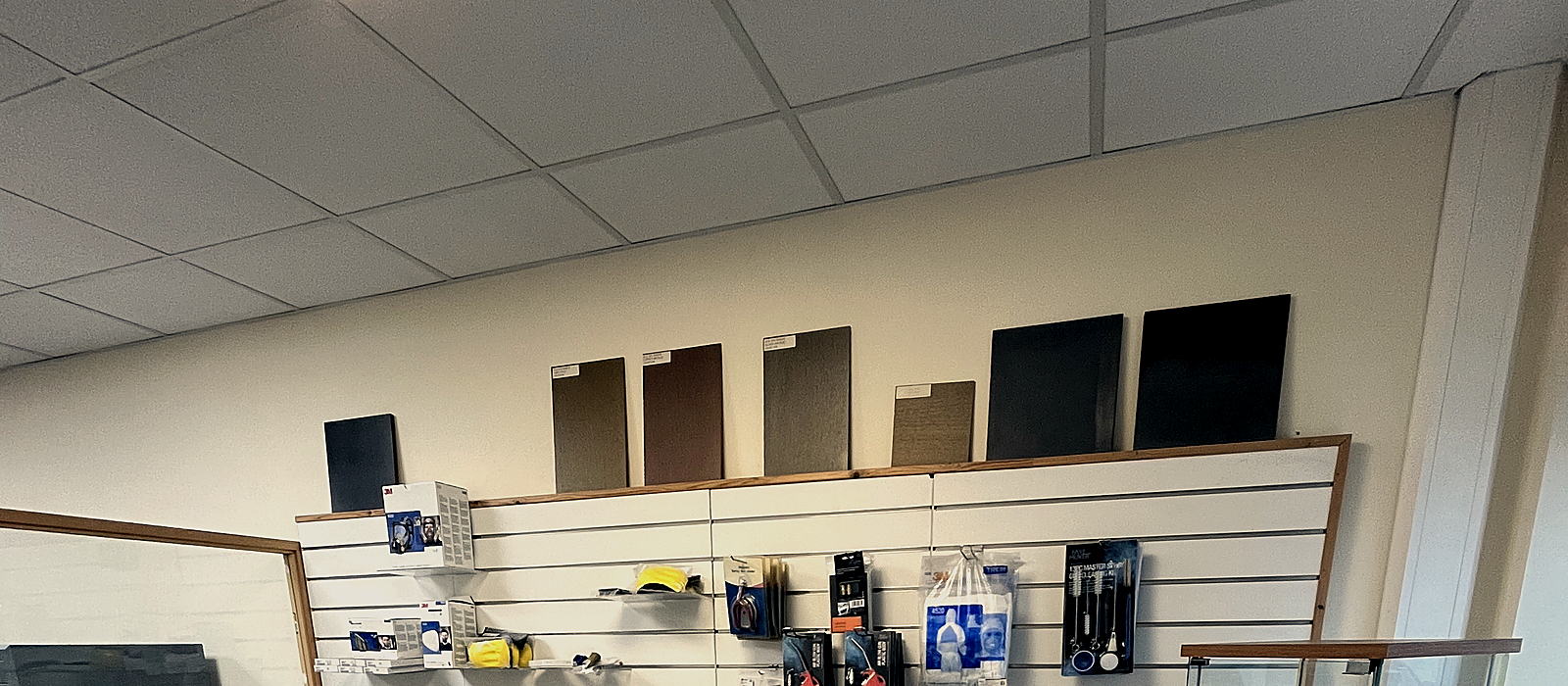
Send a sample. Get a lacquer colour you can repeat.
A Corob dispenser working from more than 50,000 formulations, a gyroscopic mixer, and a spectrophotometer for physical samples. The colour is mixed into the system you named — acid-cat, pre-cat, PU or waterborne — at the sheen the client signed off.
Colour is where a kitchen door, a hotel joinery package or a furniture line either holds together or falls apart. Matching in-house at Axis Business Park means the formula lives with people who also sell you the primer and the topcoat — not a decorative merchant mixing a wall paint and hoping it sprays.
How matching works at Lacquerite
- Fan-deck and library colours: Pantone, RAL, DCD, NCS and BS, plus Farrow & Ball, Colourtrend and Dulux references. Please ensure that colour charts are not printed on gloss paper as these cannot be scanned.
- Physical samples: a wet paint sample, a door, a spray-out. The spectrophotometer reads it; we mix a Lacquerite version into your system.
- Stored formulas: every approved match gets a code so the second batch is a reorder, not a new guess.
All colours dispensed are a Lacquerite version. If you need an exact match to a third-party decorative paint, we still need a sample. A phone photo is not a sample.
What to send so we can actually match
Label the sample with your contact details. Then tell us:
- Substrate — oak, painted MDF etc (for stains, we will require separate sample substrates that the stains will be used on)
- Sheen the client signed off (see choosing sheen)
- Quantity of product and litreage you require
- Chemistry — AC, PC or PU etc including waterborne if that is the spec. Also note if catalyst is required for any two pack products.
- Name or reference — so that when you re-order this paint you know what job this was for.
Drop samples at the trade counter or post them to Unit 12G, Axis Business Park, Tullamore, R35 NN62.
The colour has to live in a real system
We do not match “a grey” and then pick a tin. We match into acid-cured, pre-catalysed, polyurethane or waterborne. A formula stored against solvent AC is not the Sirca waterborne formula. Say which line you will spray.
Second batches and replacement doors
Put the Lacquerite colour code on the job. If you change primer, insulator, stain or topcoat sheen, the film changes and the colour will move. On white base topcoats — AC, PC, PU and the other tintable whites — a 5 litre and a 1 litre tin tinted to the same colour may differ slightly. Spray a panel from the tin you will use. That is the whole of colour matching that survives a second batch. Order before the booth is empty. A matched colour is a specified item, not a stock product. Plan the call-off against the cutting list.
How long a match takes
The colour matching process usually takes between 3–5 working days. This is due to the colour being scanned, formulated, dispensed, sprayed out, fully dried, and checked in our light box. Then necessary adjustments are made and the process is repeated. We operate on a first come first serve basis and we always try to dispatch items as soon as we can. All colour matches are sent with a sample spray-out of the matched colour and the spectrophotometer graph. There is a fee for our colour matching service.
Check it before the run
Spray a sample panel. Look at it dry, in the light the client will use. We always suggest a spray-out before committing a full kitchen or a fit-out package. We cannot accept liability for colour once paint has been applied — timber, technique and sheen all move the result after it leaves the mixer.
Disclaimer
All colours dispensed are a Lacquerite version. If you require an exact match, we will need a sample to match to. We always suggest a sample spray-out before using the colour in case of any discrepancies. We cannot accept liability for issues with colours once paint has been applied.
Common questions
How does colour matching work?
Fan-deck colours (RAL, NCS, Pantone, BS, Farrow & Ball, Colourtrend, Dulux) are mixed on the Corob from the library. Do not send colour charts printed on gloss paper — they cannot be scanned. Physical samples — a wet paint sample, a door or a spray-out — are read on the spectrophotometer. The colour is mixed into the lacquer system and sheen you named.
What should I send with a sample?
Label the sample with your contact details. Tell us the substrate (for stains, send separate sample substrates), the sheen signed off, the quantity and litreage, the chemistry including whether a two-pack needs catalyst, and a name or reference for reorders.
How long does a colour match take?
Usually 3–5 working days. The colour is scanned, formulated, dispensed, sprayed out, fully dried and checked in the light box, then adjusted and the process repeated. We work first come, first served. All matches go out with a sample spray-out and the spectrophotometer graph. There is a fee for the service.
Will the second batch match?
Put the Lacquerite colour code on the job. If you change primer, insulator, stain or topcoat sheen, the film changes and the colour will move. On white base topcoats, a 5 litre and a 1 litre tin tinted to the same colour may differ slightly — spray a panel from the tin you will use. A matched colour is a specified item, not a stock product.
Make the second batch matchWill a 5 litre and a 1 litre white-base colour match?
Not always exactly. On white base topcoats — AC, PC, PU and the other tintable whites — a 5 litre and a 1 litre tin tinted to the same colour may differ slightly. Spray a panel from the tin you will use. Do not switch pack size mid-run.
Request a match
Colour name and code, or a physical sample. Sheen and system on the same note.
Start a quoteHave a sample in the van?
Drop it to the Tullamore counter, or post it with the sheen and system. We will mix and store the formula.