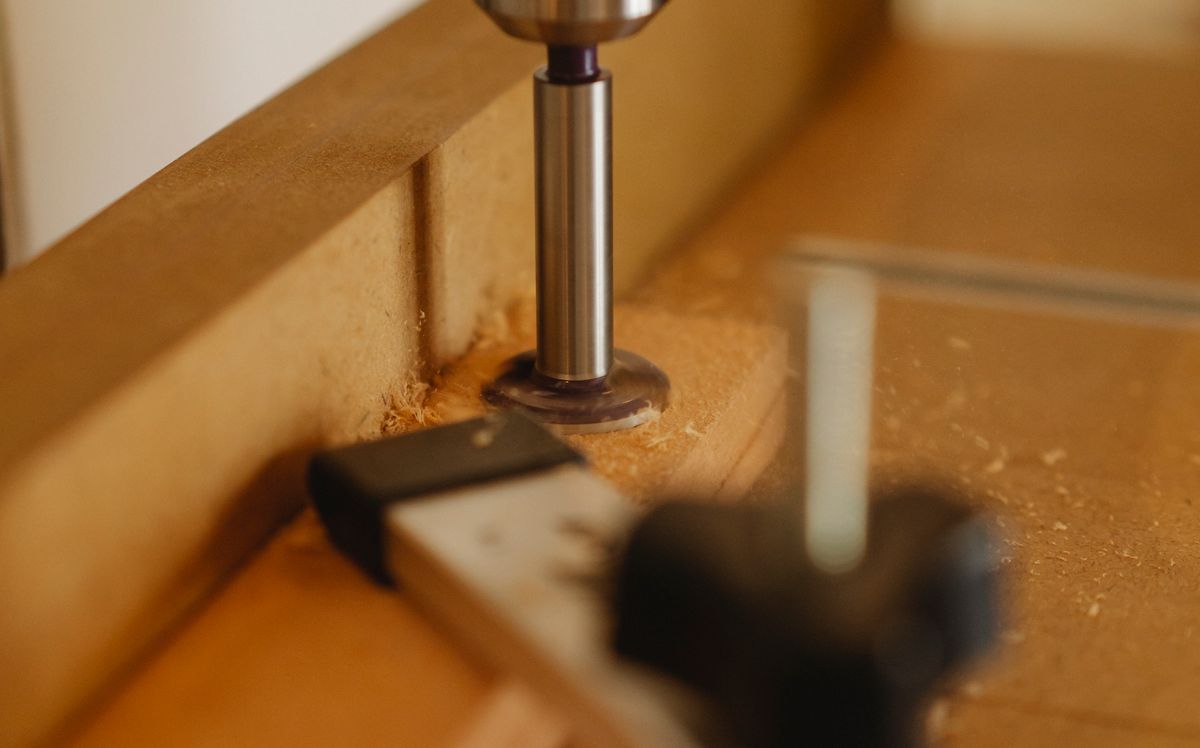

MDF is the standard substrate for painted kitchen doors, wardrobes and furniture because its faces are flat, stable and consistent. Its edges are a different material. When a router or saw cuts MDF, it opens up the fibres, and a cut edge or a routed profile soaks up primer far faster than the face beside it. Most painted MDF problems start there.
Common problems on painted MDF
- Rough or furry edges where fibres stand up through the topcoat.
- Sinkage on profiles, where the edge looks smooth after priming but sinks and goes dull days after the topcoat.
- Uneven sheen between the face and the edge of the same door.
- Primer sanded through on arrises and the tops of profiles.
All four come from treating the edge like the face.
Choose the primer from your topcoat system
Prime with the primer designed for the system you will topcoat in. Each primer is formulated to bond to the substrate and to the topcoat above it.
- Acid-cured. Novalk AC White Primer mixes 10:1 with NCH999 catalyst and comes in tinted versions as well as white.
- Pre-catalysed. Novalk PC White Primer is single-pack: thin 30% with ND4100 for a gravity gun or 20% for a pump.
- Polyurethane. Lacquerite PU White Primer NF14952B is a fast-drying two-pack sanding primer. Mix 1,000 ml of primer with 500 ml of NC942, then thin with DPU809 or ND5920, never both in the same batch.
- Waterborne. The Sirca white waterborne interior sealer primes under Sirca waterborne topcoats.
If you are not sure which system to use, our guide to acid-cured, pre-catalysed and PU lacquer compares them.
Seal the edges first
Edges need sealing before the main primer coats, so they absorb no more than the face.
- Under a PU system, Lacquerite VI1091 clear insulator isolates the MDF before the PU primer. It is used with NC942 catalyst and can be tinted.
- Under other systems, apply an extra coat of the system primer to edges and profiles, let it cure, sand it back and prime again.
Spraying the edges first, before you lay the face coat, helps the edge get the film it needs without flooding the face.
Sand between coats, carefully
- First coat. Expect raised fibres, especially on edges and especially with waterborne primers. Let it cure, then de-nib and sand smooth with a fine abrasive. This is the coat that does the work of sealing.
- Second coat. Should go on smoothly over a sealed surface. Sand it to the grade your topcoat data sheet asks for.
- Watch the edges. Sanding pads tip over arrises and profile tops and cut straight through the primer. Use a soft pad or a hand sponge on profiles.
- Check sanding times. Two-pack primers need to cure enough to sand cleanly. Sanding too soon clogs the paper and drags the film.
Remove all the dust before the next coat, from the profiles as well as the face.
Check before the topcoat goes on
If you are refinishing existing doors rather than priming new MDF, the preparation is different; see the kitchen re-spray process.
Hold the door under a raking light and look along the edges. If you can see fibres, dull patches or sand-throughs, fix them now. The topcoat will not hide them, and a gloss or high-sheen topcoat will make them more obvious.
White primer and coloured topcoats
When the topcoat is a strong or dark colour, ask us about tinting the primer towards the topcoat colour. A tinted primer reduces the number of topcoats needed for full coverage and makes small edge sand-throughs much less obvious. We can tint the AC white primer, the PU white primer and the PU insulator in Tullamore.
Get the system in one order
Give us the substrate, the topcoat system, the colour and the sheen when you ask for a quote, and we will send the insulator or sealer, primer, topcoat, catalyst and thinner together. For the mixing side, see mixing catalysts and pot life.