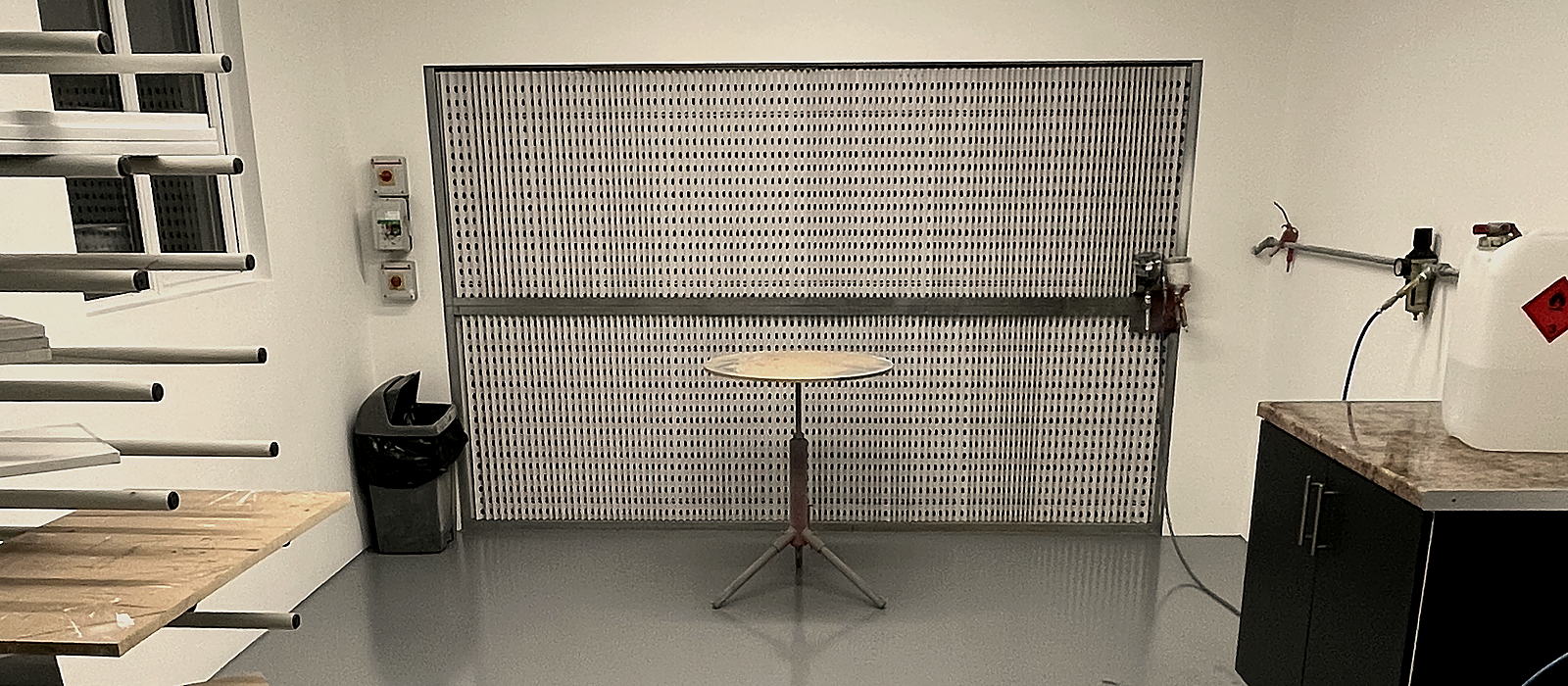
Ireland does not get many hot weeks, which is exactly why they catch shops out. The same lacquer that sprayed perfectly in May starts landing rough, skinning in the gun cup and thickening in the pot. The product has not changed. The air in the booth has.
What heat actually does to a lacquer
Every solvent-borne lacquer is a balance between solvent leaving the film and the film levelling out. Heat speeds up the first part and not the second.
- Dry spray. Droplets lose solvent between the gun and the panel. They land part-dry, cannot flow together, and the finish feels like fine sandpaper.
- Poor flow and orange peel. The film starts to set before it has levelled, so gun texture stays in the surface.
- Pinholes and solvent pop. The surface skins over while solvent is still underneath. When that solvent escapes, it leaves small craters.
- Shorter pot life. Catalysed acid-cured and PU material reacts faster when it is warm. The working time on the data sheet is the best case, not a promise.
If any of those appear on a warm afternoon after a morning of clean work, treat temperature as the first suspect, not the gun.
Slow the thinner, not the job
The fix that works in most Irish booths is a slower thinner from the same family, at the percentage the product sheet already gives you.
- Novalk AC and PC. Premium Thinners ND4100 is the standard reducer. On warm days, blend in Anti Bloom Haze Thinner ND4800. The Novalk PC topcoat sheet gives half ND4100 and half ND4800 as its anti-blooming blend, which is also a sensible starting point when the booth is hot.
- Novalk PU. Use PU Slow Drying Thinners ND4921 in place of part of the normal PU thinner.
- Sirca PU. Use DPU805 retardant thinner alongside DPU809.
Two rules stay the same whatever the weather. Do not cross chemistries: AC/PC thinners do not go into PU, and PU thinners do not go into AC or PC. And keep to the thinning range on the sheet. Slowing the thinner changes how fast the film dries. Adding more thinner changes how much film you lay down, and on a vertical panel that means runs.
Keep the material cool before it reaches the gun
Most of the damage is done before anyone pulls a trigger.
- Store tins and catalyst out of direct sun, away from roller doors and tin walls that heat up in the afternoon.
- Do not leave a mixed pot sitting on a warm bench. Keep it shaded and covered.
- Mix smaller batches. On a hot day, a pot you would normally use over a full shift may not last that long. Label each pot with the time it was catalysed.
- If a pot has thickened, gelled or will not atomise cleanly, stop using it. Adding thinner to a pot that has started to cure gives you a film that may never harden properly. The catalyst and pot life guide covers this in more detail.
Gun technique on a warm day
Small changes at the gun help the film stay wet long enough to level.
- Keep a wet edge. Work in an order that lets each pass overlap wet material, not material that has already flashed.
- Bring the gun slightly closer if dry spray is landing at the edge of the fan. Do not go so close that you flood the panel.
- Avoid spraying into warm moving air. A fan blowing across the booth for comfort will dry the overspray before it lands.
- Check pressure. Too much air pressure increases dry spray in any weather. On a hot day it shows up faster.
When to stop for the day
Some afternoons are not worth fighting. If the booth is well above the temperature the data sheet is written for, it is often better to spray first thing in the morning and leave sanding, packing and prep for the afternoon. A day lost to scheduling costs less than a run of doors that need flattening and recoating.
The same applies to large panels. A big table top or an island end gives the film more time to dry before the last pass meets the first. On hot days, plan those for the coolest part of the day.
The same booth in other seasons
Temperature and humidity cause problems all year, just different ones. Damp autumn mornings bring a milky haze on solvent lacquer, covered in why lacquer blooms in damp weather, and winter brings slow curing and soft films, covered in spraying in a cold workshop. If you are weighing up which system copes best with your workshop, read acid-cured vs pre-catalysed vs PU lacquer.
Check the data sheet, then call the counter
Product sheets give thinning percentages, flash times and pot life for a reason, and they are written for normal workshop conditions. When conditions are not normal, the sheet is still the starting point. If you are not sure which slow thinner belongs with the system you are spraying, call the counter with the product code and we will tell you. You can also build a quote with the thinner added to the order so it arrives with the lacquer.